
One message does not suit someone who has never heard of the brand and someone who is already comparing prices. Creatives for the whole funnel adapt the message to the stage: spark interest at the top, give reasons in the middle and remove obstacles at the bottom. This improves relevance and reduces waste.
The essentials in a definition
Creatives for the whole funnel adapt the message to the decision stage: top (spark interest and recognise the problem), middle (compare and trust) and bottom (decide and act). Each stage calls for its own format, argument and call to action. Campaigns such as Demand Gen and those of Meta allow segmenting messages by stage, and Think with Google studies help understand behaviours.
Stages and questions
At the top, the person does not know the brand: they need to realise the problem exists and that there is a solution. In the middle, they are considering options: they need comparisons, proof, examples. At the bottom, they are close to deciding: they need security, clear pricing, a guarantee, ease.
Each stage calls for a different tone, format and appeal.
Creatives by stage
Top: short videos, stories, demonstrations, questions, entertainment or educational content tied to the problem. Middle: testimonials, comparisons, case studies, Q&A, guides. Bottom: a clear offer, reviews, guarantee, deadlines, proof of results, a direct call to action.
Avoid asking for the purchase from someone who does not yet know the brand, and avoid generic information for someone who already wants to buy.
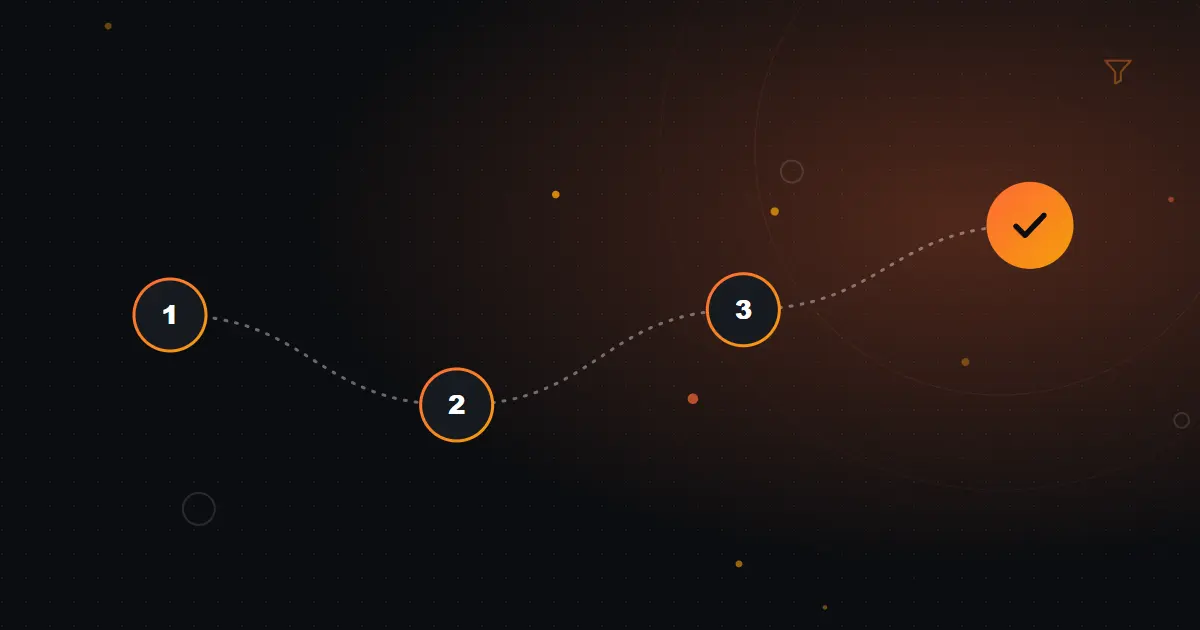
Creatives for each stage of the funnel
- Top: spark interest
- Middle: give reasons and proof
- Bottom: remove obstacles and ask for action
- Route each audience to the next stage
Linking the stages
Use audiences to route those who saw the top to the middle (for example those who watched more than half a video) and those who visited product pages to the bottom. The message should be continuous: someone who clicks one promise should not find something else.
Track cost and result by stage, not just in total.
Each stage has its own question, and the creative is the answer.
Balancing budget
Many accounts invest almost everything at the bottom, where results appear quickly, and exhaust the audience. Reserve a part for the top and middle, which feed the bottom. The proportion depends on the buying cycle and the stage of the business.
Review the split with data on new customers and brand searches.
Decision table
| Stage | Message | Call to action |
|---|---|---|
| Top | Problem, curiosity and usefulness | Watch, save or read more |
| Middle | Proof, comparison and method | Download, simulate or watch a demo |
| Bottom | Offer, guarantee and deadline | Buy, book or request a quote |
| Post-purchase | Help, complements and community | Repurchase or recommend |
Common mistakes to avoid
- Asking for the purchase from someone who just met the brand. It reduces efficiency; match the ask to the stage.
- Only bottom-funnel creatives. They quickly exhaust existing demand.
- Not linking stages. Without sequence, people are lost between steps.
How to measure the result
Measure by stage: qualified reach, pass-through to the next stage and cost per result of each step, to see where people are lost.
Limits and exceptions
Covering the whole funnel requires budget and production, and in small accounts it may be too much. If budget is limited, concentrate on the stage where demand exists (bottom and middle) and extend to the top when there is capacity. Beware of measurement: the top generates effects that only show over time and indirectly, and requires patience and suitable indicators.
Illustrative example
Illustrative example: an insurance company creates three pieces: a video explaining a common risk (top), a clear comparison of coverages (middle) and an offer with a deadline to request a quote (bottom). It links them with sequential remarketing. The bottom conversion rate rises, because those arriving have seen the earlier ones, and cost per quote falls.
Frequently asked questions
Do I need creatives for all three stages?
Ideal, but you can start with two, as long as the message is coherent.
How do I split the budget?
It depends on the buying cycle. Start with a smaller share at the top and adjust.
How do I measure the top?
With retention, brand searches and growth of the audience for later stages.
How many stages should I cover?
Three or four, depending on the purchase cycle; in short cycles, fewer stages suffice.
Do I need budget for the top?
Ideally yes, in a defined proportion; without the top, the bottom exhausts existing demand.
Creatives by stage (problem, proof, offer and post-purchase), linked by sequential remarketing, convert more than the same purchase ask aimed at everyone.
Sources and recommended reading
Last editorial review: October 2026. Informational content; always confirm current conditions in the official sources before deciding.